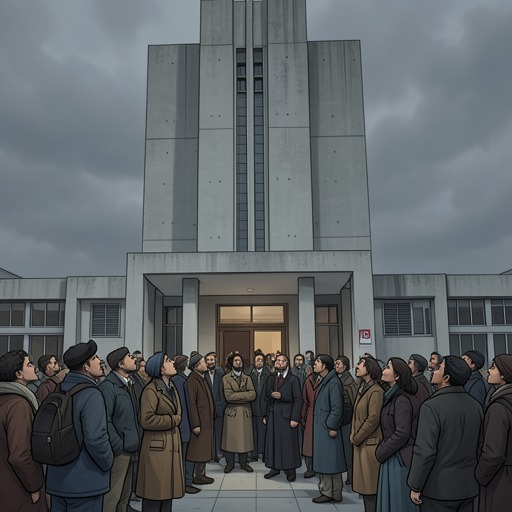
Stuttgart Public Prosecutor’s Office
The Collini CaseThe Stuttgart Public Prosecutor’s Office is the authority that investigated Hans Meyer after Fabrizio Collini reported him for the wartime shooting of Collini’s father. Its proceedings, discontinued in July 1969 under a limitation rule, become a crucial part of the courtroom dispute in The Collini Case: the office’s decision ended the investigation without resolving Meyer’s guilt or innocence, and its history helps explain why Collini later says he trusted the authorities and was met with a letter declaring the matter closed.
Investigation of Hans Meyer
The office initiated proceedings against Hans Meyer on the basis of accusations later described in court. The investigation ran from 1968 to 1969, and a file was drawn up. Yet the distinction between opening a case and establishing what happened is stark: Meyer was neither questioned nor charged, and he was not found guilty. The available account therefore records an investigation and its administrative end, not a trial or a verdict on the accusations.
The trial makes the incompleteness of that process an explicit issue. During cross-examination, Richard Mattinger asks Dr Sybille Schwan whether Meyer had been questioned; she answers that he had not. Mattinger then emphasizes the contrast between the existence of proceedings and a file, on the one hand, and the absence of a charge or conviction, on the other. He also invokes the claim that Meyer had fulfilled the criteria for a legitimate shooting of hostages. That claim is presented as part of the courtroom exchange, not as a finding made by the Stuttgart Public Prosecutor’s Office or a judgment reached after a trial of Meyer.
Discontinuation and its timing
Dr Schwan identifies 7 July 1969 as the date on which the office discontinued its investigations. She later adds a consequential detail: Fabrizio Collini received notice of the decision on 21 July. The difference between the decision date and the date of notification gives the closure a concrete sequence. Collini had reported the name of the man he said was responsible for his father’s death and supplied the evidence; a year later, as Caspar Leinen summarizes in court, he received a single sheet informing him that proceedings had ended.
When Leinen asks why the case was discontinued, Dr Schwan answers that the statute of limitations had come into force. She connects the closure to a law effective on 1 October 1968, the Introductory Act to Administrative Offences. In her account, the office stopped pursuing the case because the changed limitation rules made the conduct no longer prosecutable. Thus the stated reason was a legal bar, not a determination, following further investigation, that Meyer was innocent. The distinction matters: the proceeding ended, but the underlying accusation was not tested in a trial of Meyer.
The office’s decision in the trial
The office’s history enters the murder trial as evidence bearing on motive. After Mattinger has established that the investigation was discontinued, Leinen returns to the date and asks Dr Schwan to clarify which proceedings had ended. He then asks why. The presiding judge allows the questioning because it concerns the defendant’s motive and could influence the question of guilt. The decision to stop the investigation is therefore not treated as a detached historical detail; the court permits it to be examined as part of the case against Collini.
Leinen’s questioning places the office’s action within a wider legal history. Dr Schwan explains that, since 1960, crimes from the Third Reich period had generally been subject to a statute of limitations, while murder remained prosecutable. She describes the 1968 law as an unassuming measure that was not debated in the German Bundestag and whose consequence, as she recounts it, was initially missed by legal-administration bodies and committees. It changed the treatment of certain accessories to murder so that they were sentenced as accessories to manslaughter instead; the resulting limitation rules placed some cases beyond prosecution. This historical explanation supplies the legal context for the Stuttgart proceedings’ termination, but it does not establish what an investigation of Meyer would have found.
Significance and limits of the record
The courtroom gives the office’s decision two different meanings. Mattinger uses the discontinuation to stress that Meyer was never convicted; after Dr Schwan confirms the closure, Mattinger declares that Meyer is no longer a murderer, and Collini sits with his head bowed and tears on his face. Leinen’s subsequent questions shift attention from the bare fact of closure to its cause: Collini had reported the accusation, but the limitation rule ended the proceedings before Meyer was questioned. The contrast exposes how a legally effective decision can settle whether a prosecution continues without settling the historical accusation itself.
The novel does not present the Stuttgart Public Prosecutor’s Office as having made a judicial finding about Meyer, nor does the evidence establish that it deliberately protected him. It presents a narrower but consequential sequence: the office opened an investigation, did not question or charge him, and discontinued the case after the limitation rule had come into force. That sequence becomes part of Leinen’s account of Collini’s motive and of the difference between procedural finality and an examination of responsibility. The office’s decision closes its proceedings; in the trial, its unexamined history reopens the question of what that closure meant.